Showing posts with label pricing. Show all posts

20120723

VoLTE pricing updates

Korean MNOs are still scratching their heads to find the optimal pricing system for Voice over LTE. LTE has been around for a while, but voice is basically using older routes (VoIP, 3G...).

VoLTE is not totally transparent for the user: theoretically, connections will come much quicklier, and sound quality will improve ("HD voice"). Of course, with the boom in smart device usages, the massive transfer of voice to data scares network owners. And the government is adding some pressure to prevent consumers from being charged too dearly (said consumers happen to vote for the next President this December).

One thing is sure: unlimited plans will not be offered as easily, and operators cannot abandon totally the time reference (minutes). More than ever, in-network calling will be promoted.

MNOs met to find common ground in the future, following the disclosure by KT of key elements of their LTE strategy ("HD Mobile Wonderland") and roadmap:
- "HD Voice" trials are under way for KT, with 300 testers and a target TTM of October 2012.
- August 1, 2012: LTE-only rate plans (see below), LTE roaming.
- September 2012: LTE upgrade for ABC Services (Always Best Connected is about seamless 3G and WiFi)
- October 2012: Joyn (HD "Rich Communications Suite") -  HD Games by the end of the year
- November 2012: Olleh TV LTE upgrade from 500Kbps to 2Mbps
- Q3 2013 Multi Carrier LTE starting in Seoul. Quad Antenna


KT's LTE Warp, a service twice faster than standard LTE, already covers 84 cities nationwide, and all KTX lines. The operator aims at 4 million LTE subs by EOY 2012 (1.4 M nowadays), and stopped introducing new 3G smartphones. Note that Samsung Galaxy Note II LTE is also expected for October, and that KT's latest promotions are already preparing the transition, leveraging on the successful launch of Samsung Galaxy III LTE.

The LTE rates introduced in July ranged from KRW 37,400 to 137,500 (USD 37.5 to 119.6):
. LTE-340 (750 MB, 160 mn) adds a discount of KRW 7,700, and if you take the KRW 924,000 Galaxy III for a 24 month engagement, it will cost you KRW 68,200 (USD 59.3)
. LTE-1250 (25 GB, 1250 mn)  adds a discount of KRW 33,000, plus KRW 32,000 for the smartphone, which adds up to KRW 141,667 per month (USD 123.2) over 2 years.
If you replace your phone, KT throws in a lot of free on-network calls to keep you onboard.

The LTE rates starting on August 1 allow data roll over:
. LTE-G650 (KRW 65,000): 6GB, 350 minutes + 3000 minutes in-network
. LTE-G750 (KRW 75,000): 10GB, 450 + 3000 minutes in-network
. LTE-1250 (KRW 125,000): 25GB, 1250 minutes + unlimited in-network (KT wired/wireless)
Now if they could do something about international calls...


mot-bile 2012


20100825

15 Gigas of fame for metroPCS : Samsung Craft 4G LTE (SCH-R900)

Samsung confirmed today to Yonhap that metroPCS Wireless Inc., a CDMA player, would launch its SCH-R900 4G model (LTE with 3G CDMA) in the US. The gizmo had been announced by metroPCS last March, and approved by the FCC last month (leaks for geeks included).

At the OS level, Android remains a favorite.

At the network level, metroPCS has rolled out LTE on places where people love to show off : Las Vegas and Dallas.

At the pricing level, observers expect a $300 price tag, but even more interesting to see will be how aggressively this MNO, specialized in discount and prepaid, will price data. The Texas-based company operates on major US markets, and claims over 7 million subs.

Verizon Wireless & co won't let it enjoy TTM leadership for too long, and they will roll out more aggressively.

Until then, great opportunity to shine. How about Warholian 15 Gigas, the data equivalent to the 15 minutes of fame ?

mot-bile 2010


20100715

VoIP over 3G, unlimited data... SK Telecom victim of the summerheat wave ?

SK Telecom is lobbying in favor of a more open regulation for mobile Voice over IP in Korea : instead of being only legal on Wi-Fi, it would be authorized on 3G as well. SKT would then provide the service through Skype-like solutions - actually, I wouldn't be surprised to see some Google inside (see "Gizmo5 found its Google Voice"), and consumers would only pay for the data (not to mention fees from the app provider).

OK OK. There's a catch : data rates are pretty expensive in Korea.

Well, not so much now : SK Telecom also announced an unlimited data plan for all subs with a data package of over KRW 55,000 (about USD 45) per month. That would be for smartphone holders, but as far as I know, you can use your smartphone as a modem for greedier devices.

Alright. Here is a small operator struggling for market share, desperate to win big customers, and not worried about network capacity.

Wait a minute. SKT is by far the leader of Korea's (saturated) market, with about 51% of the pie. SKT does not sell iPhones like AT&T, whose success with Apple forced a spectacular backpedaling on unlimited data plans, but SKT is doing pretty well with Samsung Galaxy S (over 300,000 units sold for this Android handset in Korea). Its position doesn't seem that much threatened in the short term.

But what looks like a desperate defensive move following data rate cuts by competitors is also an aggressive move on convergence / quadplay offers (or is it pentaplay, now that the battle rages on wi-fi hotspots ?). Voice ? A commodity, sooner than later - losing a big customer altogether would cost me much more. And guess what ? Ultra-Broadband Convergence Network (UBcN) is around the corner (that's to say 2013 but blocks are bigger around here).

Still, unlimited data plans are a very risky bet in "ubiquitous Korea".


mot-bile 2010


20090925

iPhone wakes up Korean mobile internet market

Amazing : Korea, a world leader in mobile innovations in the early 2000s, Korea, still nowadays the land of broadband and home to such IT giants as Samsung and LG, Korea is lagging behind European countries in both IPTV and mobile internet.

As we saw with IPTV (see "
IPTV in Korea, an update"), lobbying and regulation played an important part in this paradox, and the country is finally trying to fix the bug.

For mobile internet, the first opening came last year with the abandon of WIPI (Wireless Internet Platform for Interoperability) as the mandatory platform for smartphones, opening the market to Blackberry and other players. Today, we can hardly speak of a shift from an industry-based to a consumer-based regulation, but the Korea Communications Commission (KCC) just cleared the way for iPhone in Korea by stating that Apple, after all, doesn't need an extra license for Location-Based Services as long as there's a MNO with the relevant license in the loop.

KT is expected to launch the iPhone in the weeks to come (October or November), and to subsidize the device down to a retail price of around KRW 240,000 (about USD 200). Apple wants more than the 300,000 units announced by its Korean partner, who will have to release its own KT Apps Store ahead of the iPhone in order to mark its territory. In order to leverage on the operator's strong leadership in fixed and fixed wireless services, KT's apps will be downloadable by Wi-Fi.

Competitors have been bracing themselves for the iPhone, fearing market disruptions : wireless leader SK Telecom opened the first App Store earlier this month. But unfortunately, "T Store" has been bashed by the critic : users can browse as much as they want on their PC (
tstore.co.kr - about 6,500 references), but can only download apps via their 3G phones, and via 3G only (not Wi-Fi). Worse : the price doesn't include connection costs ! Needless to say the service is WIPI-based : SKT is the mobile leader and bets on a wider installed based from the start. I can already see marketers scratch their heads : we want our customers to rediscover their own handsets and find them sexier than the ultimate hype machine... good luck ! Needless to say T Store won't remain WIPI-based : SKT plans to go "global" within two years and to generate a 1 trillion won turnover in 2013. If SKT maintains its 30% cut, we're talking about over half a billion bucks. And since SKT happens to be also a major content provider, that's a rather conservative estimation... provided the store succees, of course.

Korean developers will have fish to fry, as well as the editors' sectoral federations (ie games), in charge of okaying new apps. Furthermore, Microsoft is also roaming the country to snatch some gems (USD 19M planned for game developers over the next 4 years).

Netcos have been barred by cellcos but grow new ambitions, like NHN for its "web" brands. Beyond Naver, NHN wants to push Me2Day, a K-"twitter" acquired last year and already on iPhone.

Now How about endusers ?

Mobile TV is very popular but doesn't require 3G. And wireless internet echoes more Wi-Fi / WiBro than 3G. Even if half of the core target (12 to 59 year-olds) is somehow using services, mobile internet over 3G remains ways too expensive, and most players would like operators to slash connection costs, particularly to welcome revenues from social networking platforms. MNOs already had to undergo significant cuts in calling charges, but their rates remain high and the percentage of turnover made on wireless internet very low (below 20%) compared to advanced European nations (in the mid 30%s).

Usages are bound to soar once MNOs accept to share more with the rest of the ecosystem, to grow a much bigger pie. All together, now.

ADDENDUM 20090927

More precisions regarding the cuts in mobile charges (announced this week-end) :
- wireless internet basic rates : 50% reduction for LGT, 88% for KT. To be defined for SKT, but from next March on, the leader will calculate call charges per second (every 10 second now). note that Long Distance has disappeared in Korea : calls within Seoul and outside will cost the same. VoIP also gains ground, even if rates are not as slashed as in other countries (ie nothing is actually free).
- basic access fees slashed (KT : from KRW 30 to 24,000 - SKT : from 55 to 44,000)
- loyalty discounts (KT 5,000 / mo, SKT up to 22,000, LGT up to 25,000) - NB: all 3 MNOs have also triple play discounts. Logically, #3 LG Telecom (mobile portal brand : Oz) is the most aggressive player.


20090627

2nd Million for TU Media - 2nd country for SK Telecom - Citi JV

June 25, 2009 ? Apparently a good day for SK Telecom PR :
- subsidiary TU Media signs its 2,000,000 th customer
- JV with Citigroup launches mobile banking services in the Philippines, a few months after Hong Kong

The SK Telecom - Citibank Philippines JV (Mobile Money Ventures LLC) is definitely good news : in Hong-Kong, services were more about portfolio management than actual personal banking and transactions - what Citi Mobile Banking (CMB) is all about in the Philippines. These browser-based services shall soon be implemented in other countries, and confirm the operator's international ambitions in mobile finance (see recently "
SK Telecom's Wild Hana Card").

But is TU Media really a success ?

Many European players would love to boast 2 M mobile TV paid users, but 2 M is not even equivalent to 10% of SK Telecom's customer base and for this operator, a 10% penetration after 4 years doesn't seem very impressive.

Besides, to claim its second million customers, SKT's S-DMB unit took more time than it did for the first : TU Media was launched in May 2005 and reached the 1 M mark in December 2006.

Indeed, TU Media was in a very poor condition last year, both financially (mounting debts) and commercially (it claimed only 1.3 M subs in June 2008, a gain of 300,000 in 1.5 years). The 700k customers gained over the past 12 months are the result of what appears to be a make or break move by the owner : SKT went up in the company, injected KRW 55 bn more, and offered massive discounts to its own mobile subscribers... to the point that an undisclosed proportion of its "paid subscribers" don't have to pay to enjoy the service* !

As a consequence :

=> TU Media becomes more competitive with terrestrial accesses (T-DMB), which have been free since the beginning (launched in December 2005) : as we saw ("
3M DMB subs - SBSM on its way"), that's the reason why they are much more popular. T-DMB claims the bulk of Korea's 20M+ DMB-enabled devices (every other handset is OK for mobile TV).

=> At the corporate level, TU Media is now more a MNO's Business Unit than the initial stand alone operator. The very few people who didn't use SKT as their mobile phone operator are encouraged to join the leader, and for the rest, TU Media looks almost like an option among others.

=> TU Media has been burning a lot of cash, and a sustainable TU Media requires more differenciation, and even greater efforts :

- Technological differenciation is not necessarily positive : in covered areas, terrestrial has theoretically an edge over satellite for indoor. SKT does enjoy a truly nationwide coverage, and propose an in-car access offer (TU Rideon - KRW 11,000 / mo - 3 yrs offered for Basic) as well as a real time traffic service (TU TPEG - KRW 3,000 / mo), but T-DMB is very popular for buses and coaches.

- Content and added value services remain key, and SKT will not always surf on such events as the Beijing Olympics, a major boost for subscriptions last year (the whole population was hooked and literally always on one way / media or another)... but not very differentiating since several broadcasters offered the same images (
SBS clinched the exclusive TV rights for the next Olympic Games). The only "paid service" operator could try and lock some key rights to pimp up its own premium channels TU Entertainment and TU Sports (both available through the TU Select service : 1 channel for KRW 2,000 / mo, 2 for 3,000, 3 for 4,000). Other premium services feature TUBOX (movies PPV for krw 1,000 or 1,500 apiece) and PREMIUM 19+ (adult for krw 3,000 / mo or 1,200 for 2 days).

Still now, SKT seems to be as much pushing the service as trying to pull it out of a ditch. The technological landscape keeps evolving and in 2012, fixed and mobile broadband will reach respectly 1 Gbps and 10 Mbps. Typically, SKT is investing massively in optic cabling (from 5,000 km to 88,000 km) through SK Networks.

But mobile TV has found a public anyway, and SK Telecom is not the kind of player to abandon leadership easily. Particularily in such a key vertical.

So it brought along TU Media in its trials in Thailand, so...

... not to be discontinued yet.

But stay tuned.


* With TU Media, you pay only for subscription charges. Neither for traffic nor for content, except for movies on demand (NB: these days, KRW 1,000 is about USD 0.78) :
- Basic rates are KRW 6,000 for TU Slim (9 TV channels + 16 audio), idem for TU English (10 TV + 16), and KRW 11,000 for TU Basic (unlimited 21 TV + 16 audio)
- SKT customers enjoy a 6,000 discount on basic rates, which sets Basic at 5,000... and Slim and English services at zero


20090610

iPhone, Pre-Price War

From iPhone 3G to iPhone 3G S you get a yawn, from $199 iPhone to $99 iPhone more buzz.

When the main innovations come from pricing, you know commoditization is under way.

And commodities is not what Apple is into.

Apple is hurting Palm because this competitor will never reach the same volumes with its Tre. Apple is hurting Samsung and LG. Apple is hurting Nokia. Apple is hurting the iPod Touch but who cares.

Apple targets the feature phone market : Apple wants to smarten it up because that's the only way to increase volumes.

Smartphone penetration is bound to accelerate, and it's always better to start first in the race. Provided you're profiled to thrive in this kind of environment.

The industrial challenge requires the ability to deliver much bigger volumes (no problemo), but furthermore to become even more reactive, to cope with shorter product cycles and wider ranges, to innovate constantly...

You want to see how competition fares in the app stores arena.


20090430

Orange Hello, is it me you're looking for ?

Orange Hello is an internet computer for dummies, the word "dummies" covering the minority of techno- / PCphobes who never considered purchasing nor using a computer, and people ready to pay EUR 1 + EUR 39.9 per month for a simple play (internet access) instead of the standard EUR 29.9 per month for a full triple play... Ideally, seniors with a comfortable pension but lacking the courage to join their kids and grandkids in the internet age. Grandkids who mock at their absence of smart screens at home. Grandkids who may even not enjoy staying overnight simply because here, they can't browse the web on a bigger screen than their own smartphone.

Hello is expensive, granted, but delivers, installs, and maintains at your place a PC with an almost iMacish look : a thick 15 inch- screen connected to a keyboard and including a 120 Go hardrive, a webcam, and a broadband modem. Orange makes sure Kids can get their daily fix : features include messenging, video, music, games, web TV... (plus text to speech for their myopic dinosaur ancestors).

A little sexier than Jean-Louis Constanza's first device meant as an entry point to French households : a no-frills fixed phone that would automatically compose the 4 prefix for Tele2 France customers.

Now CEO of Orange Vallee, Constanza (who after the Swede category killer moved on to Ten MVNO) is still working on pedagogy and simplicity for new usages in daily communications, only with smarter technologies, and different budget constraints for the operator... and obviously the customer.

Hello can be considered as the big brother of another Orange Vallee device* : Tabbee, an always on, family friendly, stand alone web terminal featuring a 7 inch touch screen.

But Hello doesn't have a touch screen. So don't even dream about smearing your Hello screen while imitating John King with your greasy fingers. All you may ruin is the supposedly more intuitive and user friendly keyboard. Because believe it or not, even French dummies know how to use a keyboard.


Orange can thank mother company France Telecom for this miracle : most post Y2K seniors are former Minitel users.


* While I'm at it : "Orange Vallee"'s 2009 Summer Collection include mobile platforms (WorMee music platform, Application Shop, TV d'Orange for iPhone, Orange 24/24 news engine), entertainment accessories (Hi-Fi Adapter, Media Remote Control), business / messenging solutions (Instant Messenger for all, Visual Voicemail, Teleconference, Medical Office)... see
Orange Innovation TV for details.


20080625

Windows of opportunity

Nokia merged their S40 and S60 platforms with Symbian, and their destiny with NTT DoCoMo and SonyEricsson in the open source race against Google and the Linux family. But the Symbian Foundation is not competing with the Bill & Melinda Gates Foundation ; it's only inviting people to stop throwing money out of the Windows, and to put Apple in the same (waste ?) basket. The aim is not to become the sexiest techno on the market, but to make sure the bulk of the value remains in familiar hands.

Which could be a moto for Qualcomm. The San Diego Chargers want to surf on ip.access' success in femtocells, and their strategy is to purchase the joint and collect the royalties. Business as usual, but will ip.access remain as popular ? Will Qualcomm succeed in closing the door to competitors or in motivating them to enter through the windows ?

Virgin Mobile USA decided to open wide both in a Totally Unlimited move : get all you can spit voice for $79.99 / mo, and add 10 bucks for a data combo. Some commuters may prefer working from home to spending a little bit less than a hundred a month for a little bit more than 20 gallons of oil.

Samsung SDI Co designs windows that generate solar power. This BIPV (Building Integrated PhotoVoltalic) technology could help Korean buildings become more energy efficient. Or Korean mobile phones to charge while catching a sun tan ? Uh. Not such a brilliant idea. My deduction is that induction will do this at a quicklier and safer pace (more "electric Wifi" demos are expected this August at the IFA / Internationale Funkausstellung in Berlin).


20080524

Korea : 2G WiBro South, 3GSM North

North Korea (or at least certain parts of the hermitest kingless kingdom) has been enjoying 2G GSM since 2002. And for an even more restricted public since 2004, after the train explosion rumored to be an assassination attempt against KIM Jong-il.

Now the Dear Leader can enjoy movies on the go even outside of his personal bunker-train. CHEO Technology (a Korea Post & Telecommunications / Orascom - 25% / 75% - JV) was awarded a 25 year 3G W-CDMA license earlier this year and obviously started investing ($ 400 M for the network and the license).

Cross the border, China Unicom has been stripped of its CDMA network. New investments in online gaming (30% of Hong Kong's Magicgrids Networks and partnerships with its mainland China Magic Tech Network subsidiary) did not make up for this great loss for SK Telecom.

But the Dear South Korean Mobile Leader announced this week a successful real-time HD video trial of its Wibro Wave 2 : this 2G WiBro claims rates of up to 10Mbps / 37Mbps (up/downlink) will be rolled out across the capital (TTM H2 2008).

SKT wants to market Wibro Wave 2 cheaper than 1G WiBro. KT started its service much later but leads the market. Besides, it is merging its customer service units with KTF and the merger of the two companies seems everyday more probable.

And the competition is raging, forcing MNOs to slash prices for data (ie -30% for SKT phone-mail) and increase marketing expenses (+30% YOY for SKT 2008Q1 - handset subsidies frenzy is back). No wonder SKT's operating income went down 16.3% in 2008Q1.


The worst may be coming : as of July, USIM lock will end and Koreans will at last enjoy the fun of handset and operator switch.


20071121

Kindle Kindle little star - take my Word

The first of its Kindle ? Over the past decade, we've seen much nicer ebook readers than Amazon's ugly $399 gizmo. The size, weight, shape, vertical scrolling, the next / previous page system, the keyboard, or E Ink are cool, but Kindle is definitely not meant for LG Shine nor iPhone lovers - even though one may find a couple of book readers* among those.

And anyway, the aim of the game is not to propose the sexiest device but to set the standards for ebooks. Beyond hardware, this is about softwares, formats, DRM... and sustainable business models.

And this is truly wireless. Not Wifi but CDMA2000-EVDO (as usual, Sprint Nextel provides the radio for a new disruptive player). But the customer won't be charged for airtime.

This is not a phone but a reader with a restricted connectivity : the main revenues are supposed to be books. A New York Times Best Seller or New Release will sell for $9.99, and overall, there are over 88,000 books available in the Kindle Store (
amazon.com/kindle). And Amazon has already been a 99¢ store for paperless short stories for over two years**.

Compulsive readers could help Jeff Bezos break even, but he still needs to make sure all buyers will actually use the device on a regular basis. Usages that bring the dough, not like reading on and on the same thing (including The New Oxford American Dictionary included in the purchase).

Well. This reader has a rather restricted connectivity (dubbed "Whispernet"), and the only way to read something that wasn't imbedded is to access or download it over the air. Amazon offers all you can read Wikipedia.org, and you can browse for hours the store - no doubt other things can be ordered this way, but no card reader for book readers, and the capacity is limited to 200 titles (500 to 800 k files). AmazonKindle kindly declines files that are neither Word documents, nor pictures (.JPG, .GIF, .BMP, .PNG), nor HTML, nor TXT.

You can download such files through a personal kindle e-mail at the rate of $0.1 each. That's a start. You can subscribe to blogs and news services from $.99 / month each. That's getting juicy. And Amazon can bring partners or open the web step by step and cent by cent as they please. That's smart to start from such a low point, but I'm not sure everybody will follow all the way.

Whatever. The proof of concept would help Amazon export this service to all other devices. And turn 3G handsets and PMPs into even more multimedia players***. Come on. You don't need 3G just for a 500 to 800k file every other month.

* I mean actual books, not the Bridget Jones / Devil wears Prada / Shopaholic series.
** see "
Google Mob (pay .99 for the unshorted version)" (20050823)
*** after all, you can already use your PDA or iPod or iPhone as a sort of ebook


20070720

Super 3G trials

NTT DoCoMo announces the end of Super 3G / LTE development in 2009, starting these days with an indoor trial at 300 Mbps downlink between two gizmos. You don't want to stay in that room unless you need a perm. DoC also created CXD NEXT, a 40/60 JV with Casio Computer mating cash registers with mobile devices. iD, FeliCa, ToruCa, and others are rumored to attend the wedding as key witnesses.

RIM announces the BlackBerry 8820, a dual mode 2GSM / WiFi smartphone. SMART enough to switch from one network to the other during a PHONE call. You wouldn't want to use WiFi for secured data sessions, would you ?

Orange UK and PC World announce the "free" laptop for £ 337 (£ 14.99 per month for 24 months, except the first 3 for half the price - and you get a 2MB connection with a monthly limit of 2 GB). You may prefer their £ 300 subsidy on a few other references, or another provider with a better and cheaper free package.

Informa informs us : 6.2% of all W-CDMA subs were HSPA at the end of Q1 2007 and 20.5% will be by EOY 2008. Oh BOY.


20070619

Near Failed Communications

Can you hear me ?

Qualcomm makes sure everybody heard about PCCW's MediaFLO trial. From May 14 to November 13, 2007 (including the kick off of the 2007-2008 Premier League season, a PCCW exclusivity), the Hong Kong leader will try "to assess the potential business model of a commercial mobile television service based on MediaFLO - an open, mobile broadcasting technology - if such a service were to be launched in Hong Kong".
The service will be launched, all right. With or without Qualcomm is another story, but PCCW is willing, as Vodafone would say, to make the best of now TV. This quadplayer is already a TVNO (PCCW Media Limited) and a TV-VNO (PCCW-HKT Telephone Limited), and now TV claims 800,000 subs and 130 channels 4 years after launch (September 2003).

Can you see me ?

SK Telecom introduced their "3G+ Streaming Video Customer Center" to Korea's 160,000 hearing-impaired people. In such a competitive market, the niche is big enough to justify a specific answer, not to mention the obvious PR / image benefits.
SKT clearly mean go beyond appearances : 4,100 W120 streaming video-enabled handsets donated in April 2006, consultations Monday to Friday 9 AM to 6 PM free of charge with operators trained for all the needed languages (and the possibility of streaming video chatting), SMS transmission rates and call traffic rates offered, 35% discount off monthly flat rates...

The path is difficult : "to date, about 1,800 customers are able to use the streaming video service". Not even 5% of the 36,600 hearing-impaired people registered to the regular SK Telecom Customer Center...

Can you copy me ?

5 years after IPO, Yahoo! hired Terry Semel as their top gun. 6 years later, Jerry Yang takes his job back.
Yahoo! failed to compete with Google, but the incumbent gets ready for new bold strategic moves / partnerships / sales / all of the above.
If I were Big G, I'd be careful of the Airbus Syndrom.

Can you read me ?

Wibree joins the Bluetooth SIG - less tooth grinding for Nokia's researchers. So long babee wibro wanabeee.
The NFC Forum just e-mailed me some very disruptive news : unlike the rest of my daily spam, their previous e-mail couldn't reach my mailbox. Near Failed Communications ?

Still looking for the sign "Big bucks stop here".


20070213

3GSM 2007 - A brave new World ? A new and improved Vodafone ?

This week, Vodafone decided to send a few messages to the market :
- Purchase of Hutchison Essar ($11.7bn for a 67% controlling stake... provided Essar doesn't launch a counterattack tainted with economic patriotism*) : I intend to remain in the World's top 3 operators for subscribers and I'm gonna post exciting growth rates for the years to come. Certainly not for ARPU but I'm investing for the long term. And by the way : I'm still able to invest for higher purposes than the loyalty of my shareholders.
- Another deal with Orange on 3G network sharing : I prefer to invest on CAPEX in India where it will make a difference. I'm bracing for a fiercer competition in mature markets, where I will focus on service.
- An impressive collection of old and new partnerships with almost all major web players (Google for mapping, Yahoo! and Microsoft for IM, YouTube, eBay, MySpace...) : you think these newcomers are smarter and swifter, and you believe they will get the bulk of the value but look ! everybody wants to work with me and I'm certainly not begging for partners. They know who's ruling the game and you don't want to miss this train or else...

At last the big red machine decides to move. But I cannot see much disruption out there. It actually looks like their last smart move in Turkey, only at a bigger scale. I'd like to have more movements in the home / office spheres. Beyond WCDMA900, that is (Nokia providing UMTS900 for SFR after Portugal and Finland). To be continued...

Otherwise, 2007 doesn't look like a year for new paradygms :
- Qualcomm still wants to be the King of the Universe, but its Universal Broadcast Modem (UBM) combines MediaFLO technology, DVB-H and 1seg / ISDB-T without caring much for DMB... a slap on the wrist for those naughty koreans who want to kick it out of their country.
- Quadplays are getting mainstream. The Virgin-NTL combo, Virgin Media, charges £20 for 2, £30 for 3 and £40 for the first no-frills quads (the 125 pound gorilla offers unlimited calls in the fixed arena and 500 mn of mobile babbling plus a monthly data package including £60 in airtime and 1,000 SMS, along with the hardware - handset and PVR). Virgin Mobile will also strengthten its controlled distribution.

- Either terrified by Viviane Reding or cornered by an ever tougher competition, O2 extends My Europe to 31 countries. For £10 per month or £60 per year, business subscribers to My Europe Extra won't be charged for incoming calls whatever the network on which they are roaming. Intraeuropean calls will cost 25p per mn flat.

That could be the best news for 2007 (but for MNO shareholders) : the landline / mobile gap in calling rates is bound to decrease even before VoIP gets fully mobile. The competition goes beyond mobility and furthermore, from the customer's point of view, that's the minimum you could expect from convergence in a broadband world.


* Voda downsizes its participation in Bharti but still keeps a few toes in the venture.


20070202

embedded 3G+ and better rates

Strategy Analytics expects a 60% boom for embedded 3G in 2007.
Wi-Fi has already found its slot on laptops*, WiMAX's democratization will take some time, and 3G offers the best bitrate / security / continuity of service mix around.
In the transitional period before the industry adopts embedded connectivity, PC cards will not be as trendy as they used to. USB modems are cool and more consumer-oriented. Less PC-oriented, too, since more devices are to become 3G enabled. SKT proved it last year (with T Login**), KTF a few days ago (with iPlug, a SBSM - Single Band Single Mode - W-CDMA service), and Verizon Wireless today (launching its EV-DO Revision A service with the Novatel USB720 modem announced last year).
Laptops are definitely ripe for embedded 3G and if possible, embedded HSDPA. W-CDMA was too light for many applications run on a laptop, and HSDPA keeps rocking and rolling across the globe. Even in Korea, the country formerly known as Qualcommland, where LGT will launch EV-DO Rev A during the second half : both SKT and KTF are dumping cdma2000 for the W-CDMA - HSDPA - HSUPA - HSOPA roadmap, both will enjoy a nationwide HSDPA coverage this year, and both mean business.
KTF, for example, did launch iPlug with a USB data card, but intends to HSDPA-enable 50% of its handset line-up this year and 90% next year. KTF will have migrated half of its customer base from CDMA to W-CDMA and beyond by 2008 and 100% by 2012.
There is already a fierce competition in subsidies, and data rates should follow soon. SK Telecom just decided to reduce the data fee ceiling (and the level from which benefits are given) from 200 to KRW 150,000, and to slash its "Ting Data Free" flat data rates for teenagers by 30%. Officially, heavy bills deter many customers giving it a try without a flat rate offer (a generally binding and expensive item). But if boosting new usages sounds a noble cause, defending leadership may be a more plausible motivation for Korea's leading MNO : KTF proved a better competitor last year and will strike very hard in 2007. A new marketing culture is being pumped into KT's bureaucracies at the best moment : after years of regulatory hurdles, IPTV and quadruple plays will at last blossom in the Land of Broadband.


* it should keep spreading though, as the extension of the fixed sphere it was meant to be, and often on voice-centric devices - as it does through quad play offers
** see "T Login for HSDPA, EV-DO, WiBro and YouNameIt" (20060920). But today, I would be surprised if SK Telecom and Samsung were not considering embedded 3G+ as a part of their recent international partnership.


20061222

Is SKT's MelOn-opoly MP3 game over ?

One day SK Telecom is fined 3.8 billion wons for illegal subsidies and the next 330 million for anticoncurrencial behavior in the mobile music field (these days KRW 1,000 = about EUR 0.827 or USD 1.090).
Even ten times lower, the second punition could be most bitter to swallow : if "subsidies" were a simple breach of clearly written rules (decision by Korea Communications Commission), market dominance demanded a much more complex analysis and reached a much higher level (decision by the Fair Trade Commission). In any case, two blows in a row cannot be considered good news.
The KCC gave SKT 60 days to allow the subscribers to his service to play MP3 files downloaded from other providers.
As seen earlier in these columns, MelOn is Korea's favorite flavor in the juicy market of mobile music, with millions of subscribers paying 5,000 wons a month to download from their mobile phone as well as from the web. Yet, it gives SKT the music major a 60.2% market share on the mobile music market which is only slightly over that of SKT the mobile operator. This isn't what I would call a MelOnopoly. But from the "customer share"'s point of view.
SKT appears to be eventually experiencing the drawbacks of its pervasive strategy, and may not remain free of entering any given market without assuming the burdens of his leadership in mobility. At home at least.
On the other hand, compelled to open up its entertainment / financial / you name it activities could lead it towards even higher ambitions.


20060920

T Login for HSDPA, EV-DO, WiBro and YouNameIt

SK Telecom having a knack for new brands and new technos, customers must be struggling to keep the pace with the operator's launching machine.
T Login isn't Deutsche Telekom's latest Business Unit but a key to all SKT wireless data accesses (3G EV-DO, HSDPA, WiBro... or why not TD-SCDMA tomorrow* ?) for all devices (laptops, PMPs, digital cameras, car navigators...).
And which common denominator connectivity do you think they picked up before embedded solutions - T Login inside - are available ? Neither Bluetooth nor a vulgar 802.1x wannabe, but Korea's ultimate entry point : the USB.
Yet another proof of SKT's priorities, the first T Login modems will start with HSDPA and add WiBro on time for Xmas and at full throttle 3 months later**. Thanks to KRW 190,000 subsidies, retail prices are slashed to KRW 50,000 or about $ 50, which reflects the importance of this new entry point. SKT decided to boost the buzz by recruiting 30 "quality reviewers" on the web besides the usual pilot testers. Service rates range from KRW 29,900 per month for 2GB (+ KRW 184 per additional MB) to KRW 45,000 for 3GB (+ KRW 123). To be compared to, say, a basic fee of KRW 33,000 for Hanaro Telecom's unlimited Fiber LAN access for cyber apartments.
Overall market is estimated at 2 million people, with the usual suspects mobile office workers and road warriors among core targets, but also students because the group intends to embed its major entertainment brands MelOn, cyworld & Co. too - hell, they even offer dodoris as prelaunch incentives ! In a country where PC cards failed, HSDPA does stand a chance and SKT can leverage on security advantages as well as roaming perspectives for business users.


* since the techno is about to enter
Korea (see "TD-SCDMA in Korea" - 20060901)

** No S-DMB in sight and anyway TU media didn't communicate much after the launch of free T-DMB services while KTF claimed 164,000 customers end of May.


20060721

La3 Live - Berlin or Bust - Aussie Yield Management

Remember when 3 snatched the mobile rights for the 2006 World Cup ? HWL's unit certainly didn't get all its money back but its PR teams make sure they made the most of it, even where they didn't pay. Some feed back from 3 World Cup participants : England, Italy and Australia.

  • 3 UK claimed 3.6M viewings for its World Cup mobile TV channels during the competition. That's a 61% increase vs May and an average 106,000 per day but also, less impressively, the equivalent of one viewing per customer (3.5M overall). According to the operator, two programs proved quite successful : World Cup Highlights lured enough people everyday to fill Highbury (38,500 seats - make that one third of the total) and Berlin or Bust did 17.5% of the traffic.
    The most popular World Cup TV highlights were about England's glorious victories against the World's top 3 teams (Trinidad & Tobago, Paraguay and Equador), Zidane's infamous nod on Materazzi, and obviously the most important Becks-free game (Spain vs Ukraine - how many 3 handsets for the Rafael Benitez squad in Liverpool ?). The Berlin or Bust program was specifically designed for the event and users didn't have to pay anything to view it... well anything but 30 second ads for Canon, thanks to 3's marketing partner 4th Screen Advertising.
    In order to keep the show rolling and do better than the English team (no Berlin, just bust and crack some nuts), 3 offered through its Pilot Pitch unit a prize for the best mobile TV concept : TV producers can earn up to £50k for the funding of a pilot.
    -
  • In Italia, Tre bet on DVB-H technology with the usual suspect (Nokia). La3 Live and its 9 channels were launched on June the 5th, right before the World Cup. The daily costs depends on the duration of the formula : 3 euros if by the day, 1.5 euros if by the week, 50c if by the semester. 3 expect 20% of the pop to use mobile TV by 2010 and targets 500,000 users for La3 Live by the end of the year. After 6 weeks of operation closely linked to the major sports event of the year, the cellco claims 110,000 users, and only give few insights about usage patterns (mostly outdoors, 40% of the time during office hours).
    -
  • In Australia, 3 used the World Cup as a perfect yield management tool for its network : the games were played late at night and for AUS$ 8, you could have unlimited WC packages (videos, highlights and scores). On June 21st, 3 claimed 300,000 views after 12 days of competition and right before Australia-Croatia. Sessions lasted an average 6 mn, but some watched the whole game vs Japan... I hope none of these happy fews enjoyed a battery failure right before the Hiddink Boys' late come back.

Note that during the competition, 3 knotted a partnership with Yahoo!, who happens to be the FIFA's top internet partner.


20060619

Virgin SugarMama and the mother of all mergers

After Fujistu and BenQ, Nokia inherits part of the Siemens DNA... Will a fourth wedding mean the funerals of Siemens ?
To tell you the truth, no one cares : Siemens has never been the sexiest of all brands, nor mobile networks the most glamorous part of the business. The only question could be "WHEN will Ericsson tie the knot with another Asian partner ?"


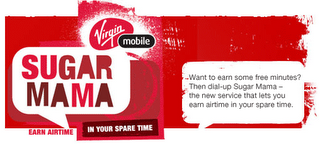
Meanwhile, Virgin Mobile USA brings the old airtime-vs-ad concept to another level : teens are lured by a generous Sugar Mama (sugar daddies being not that PC) who offers airtime to those who give her some attention. It's an opt-in thing where innovation lies in the multimedia flavor of the candies :

  • "ADTIME: Watch short online video spots and give your feedback.
  • TEXTIME: Answer questions via text message.
  • QTIME: Fill out brief surveys about brands, products, and services."

Besides and unlike session-by-session formulas where people have to undergo ads right before calling, Sugar Mama smarly leverages on its customer's "spare time".

The day is full of time outs when watching ads can be something else than a chore. That should be stimulating for admen as well.

Unlike at the network level, you may not have to tie tighter knots to lock your customers and partners.


20060604

Watcha sure, but who's gonna paya

Under the "Watcha - TV goes mobile" motto (but with a SGH-P900), debitel started their T-DMB service on time for the World Cup*. Fernsehen macht Spass but also money : €9.95 per month... I'd rather invest in a digital TV USB key or player (both are selling fine in Korea and advertising started in Europe).
In a quite sober press release, Samsung reminded their readers they also provided DVB-H handsets for the Italian market - it's not us vs them, after all. This small operation with a minor VNO is just a PR thing... we don't want to fight with European majors - nor leave them in the hands of Nokia.
If European big league MNOs are definitely interested in mobile TV, right now they're doing a lot of noise at the top of their voices. Actually, voice reached its top and time has come to slash roaming rates. The anti-Vodafone alliance reacted to Vodafone-and-3's announcements but once more, a not so impressive way : T-Mobile, Orange, Wind, Telecom Italia, Telenor and TeliaSonera proposed common goals for October (retail max €0.45 / mn) and next year (max €0.36 / mn), but Telefonica-O2 declined in order to salvage their golden goose beyond the 2006 summer season.

* Watcha :
www.watcha.de and www.debitel.de/tv.


20060525

Free broadband for broadwallets

Back to the future : remember the panic seizing operators when the "free internet" tidal wave landed on their shores ? We're back at it and with a larger magnitude.
But this time is different. Operators surf the wave and just unleash a small part of the potential of truly convergent offers.
After Carphone Warehouse and BT, Orange UK announced a free broadband bundle. Actually, you have to subscribe to Orange the mobile service to get Orange the fixed broadband service for free. In other words, Wanadoo is dumped a second time within a few weeks.
So even these days, there's no such thing as a free service. For instance, "Free" requires paying £20.99 per month at CWH.
Vodafone are expected to announce something beyond their getting rid of Arcor or a few of their top execs getting rid of their positions.


Copyright Stephane MOT 2003-2025 HOME - Today's wireless headlines - Korea wireless news - all posts (full list) - useful links - stephanemot.com (personal portal)
my books : "dragedies" - "La Ligue des Oublies"
my other sites : blogules - blogules (VF) - Seoul Village - footlog - Citizen Came - Copyright Stephane MOT 2003-2022